Teaching purpose
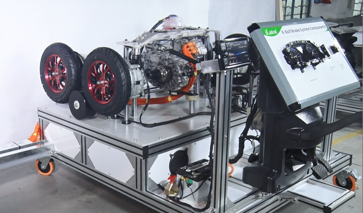
The e-Golf brake system components are made based on the original vehicle motor drive system and ABS braking system. The motor drive system adopts a three-phase drive motor with single gear step-less speed change. The training platform has an intelligent fault assessment system, which is suitable for the teaching of structural principle cognition and maintenance training of new energy pure electric vehicles in vocational and technical colleges, general education colleges, and training institutions.
Product features
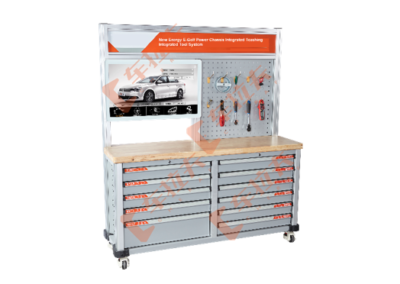
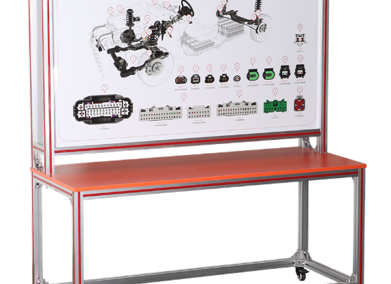
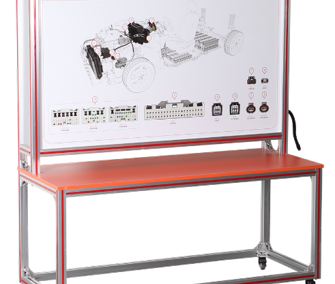
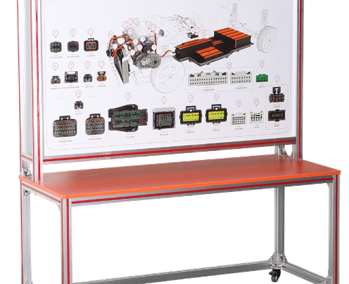
- Modular design: the motor drive system and ABS braking system adopt modular design. The original vehicle drives motor, cooling water pump, radiator, front and rear drive wheels, ABS control unit, low-voltage iron battery, accelerator pedal, shift lever assembly, combination instrument, EPB brake switch and start switch are fixed on professional base and operation control panel. The base is designed with low-voltage signal No.1 line and high-voltage output line slot, high-voltage line installation is equipped with safety signs, so as to identify in the teaching process.
- Keep the original vehicle line connection: the motor drive system training platform is connected with the original vehicle wiring harness, and a parallel detection terminal for measurement is installed next to each harness plug, which greatly reduces the line loss in the signal detection process. The parallel plug is marked with the pin number, which corresponds to the pin number of the original circuit diagram, so as to meet the requirements of pure electric vehicle motor in the training process Low-pressure signal detection of drive system, combination instrument, and brake system. The relevant signals of each control unit are connected with the vehicle controller through the original vehicle harness, which can meet the data diagnosis and dynamic data flow reading function in the process of practical teaching.
- Intelligent fault assessment system: it is composed of two independent systems: the teacher fault setting terminal and the student answering terminal. The system is installed on the mobile terminal. The mobile teaching terminal connected with wif can be connected with the fault setting module of the training platform for fault setting. After the fault setting is completed, the students use the mobile learning terminal for examination and answer, and the results after the assessment are automatically stored in the device execution module, which is convenient for teachers to query the scores of each student. The intelligent fault assessment system also has the functions of password management, fault name editing, assessment time setting, fault typesetting, and fault recovery testing.
- Product process standard: the frame of equipment base is constructed of two kinds of integrated all-aluminum alloy profiles of 40mm × 40mm and 40mm × 80mm, which is oil resistant, corrosion-resistant, and easy to clean. The electrical installation part is manufactured in strict accordance with the EU CE electrical certification standard. The whole set of wiring harness adapts the connector with safety strength up to IP64 military industry level, and the harness damage caused by long-term training can be directly replaced in sections, Avoid worries.
Supporting teaching tasks
Each set of equipment is equipped with corresponding course resource package, which is reflected in the form of training tasks. Each training task includes six links: task description, task objective, knowledge preparation, task preparation, task implementation and task assessment. Some examples are as follows:
- Training task 1: composition, structure cognition and application explanation of brake system;
- Training task 2: transmission system composition, structure cognition and application explanation;
- Power drive and energy recovery of three high voltage system in training task;
- Training task 4 hybrid braking control strategy of new energy vehicles;
- Training task 5: motor temperature sensor measurement practice;
- Training task six motor speed sensor waveform measurement;
- Training task 7 troubleshooting of motor drive system;
- Training task eight sound wave system composition, structure cognition and application explanation